Soon the fun part will begin in earnest, as Lyndie packs her one small suitcase and attaches the bright-red luggage tag she has received from Viking River Cruises. (She never checks a bag when she travels.) Her other preparations began long ago.
She “officially launched” her homework program for travels to Eastern Europe on October 23, she told me, “by re-reading a marvelous book called Balkan Ghosts by Robert Kaplan, which richly follows the history of the five countries we visited [on the first cruise]….I had forgotten a lot of the details.”
Afterwards, she turned to reading about Romania, which brought the following revelations:

- When hitch-hiking in Romania, use your finger, NOT your thumb, to catch a lift. The thumb will get you nowhere. “Calculated risk for ladies, I suppose,” Lyndie mused. “Choose carefully which finger to use.” (We assume she will not need to use this tip.)
- In northern Romania, where few can afford cars, anyone hitch-hiking attracts sympathy and most drivers will pick you up. (Interesting but irrelevant: The trip will take her nowhere near northern Romania.)
- One excursion for which she would have to pay extra (and won’t) would take her to Bram Stoker’s Dracula fantasy castle in the Carpathian Mountains of north-central Romania. However, the historical character, Vlad the Impaler, actually had his kingdom and castle in Wallachia, the broad southern plain of Romania (think of Kansas), which she already traveled via bus during the first cruise, enroute from the Danube to Bucharest.
- Vlad the Impaler was a “most unpleasant character,” she wrote. “Stoker got that detail right, anyhow…The Dracula castle tourists visit is a fake, a la Disney World.”
- “I read somewhere that U.S. money is not accepted in Romania. But no one ever refused the U.S. cash I offered as gratuities!”
Her observations about Romania were trivial and humorous, but like most of the region, the culture and history of that country is darkened with domination and brutality. For all of us (my husband and me, Lyndie and her blind companion), the main reason we paid Viking River Cruises to float us down the Danube two years ago was that we would not feel safe going to those parts of Europe unprotected and unguided.
Because her Jewish ancestors migrated through Romania on the way from Syria to Germany, she has had a personal interest in the history of that region, particularly during the Nazi era. During the first cruise, she leaped at the opportunity to visit the synagogue in Budapest – one of the few to escape destruction by occupying Nazis – while her companion was resting in the hotel before boarding the boat.
She has been studying the troubled history of the Balkan countries for many years, so much that it wearies her to talk about the details. Her most significant reference guide has been a 1,175-page volume by Rebecca West entitled Black Lamb and Grey Falcon: A Journey Through Yugoslavia. She has gained more direct knowledge about the region from a good friend who lives in her apartment building, a man whose parents came from Serbia.
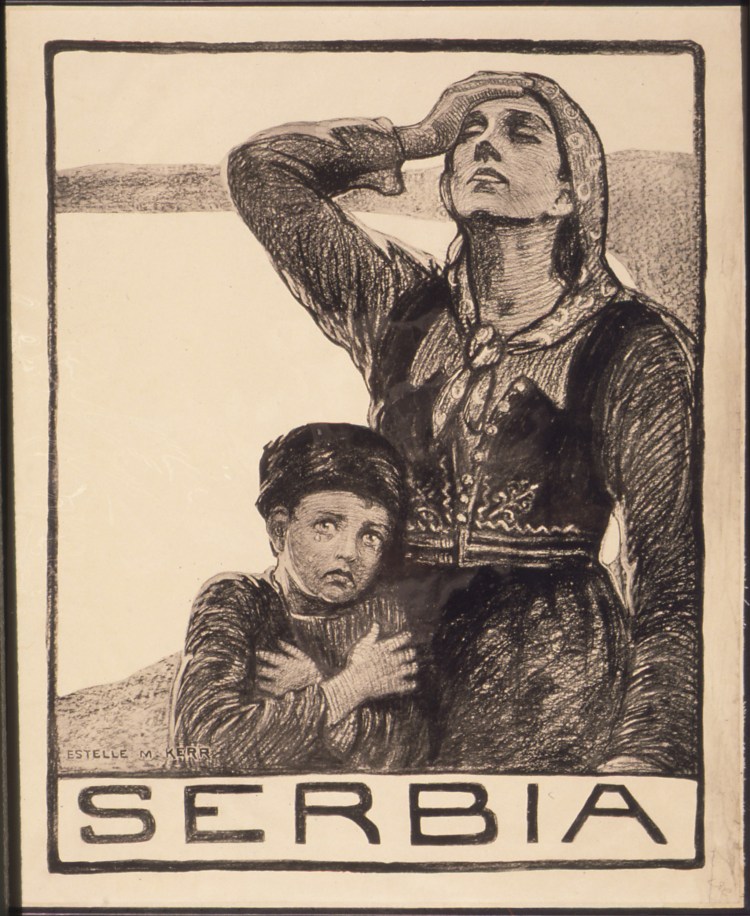
He “often recounts with a shudder the stories he grew up with of Ottoman Turkish atrocities in his father’s village in southern Serbia,” she told me, “also Nazi (then Soviet) atrocities in his mother’s city Novi Sad, near Beograd [Belgrade].” (Lyndie always uses the local name for that city.)
“Our program director on [the first cruise] was a Serbian woman from Novi Sad, with similar memories of her parents’ stories,” she wrote. (Count on Lyndie to ask the cruise director about her own history.) She added that “Serbians’ own atrocity stories abound, of course.”
One of the excursions away from the boat offers a first-person opportunity to learn about that, during a visit to a private home in a mountain village in Croatia. The travelers enjoy homemade pastries while hearing what it was like to endure the horrors of the Serbo-Croatian conflict during the early 1990s, when Serbia violently disputed Croatia’s claim to independence.
That was just the latest upheaval in the tragic history of the Balkan people, which reaches back through thousands of years of domination by different invaders, to the time of the Roman Empire. All of them wanted control of the region surrounding that Danube River, with its access from the center of Europe to the Black Sea, the Mediterranean, and the oceans of the world.
The turbulence continued into our lifetimes. Near the beginning of the last century, an assassination in Sarajevo in what is now Croatia set off the first global war. Near its end, during the violent breakup of Yugoslavia after the death in 1980 of its “benevolent dictator” Tito, a massacre in the village of Srebrenica was deemed the worst act of genocide after World War II.
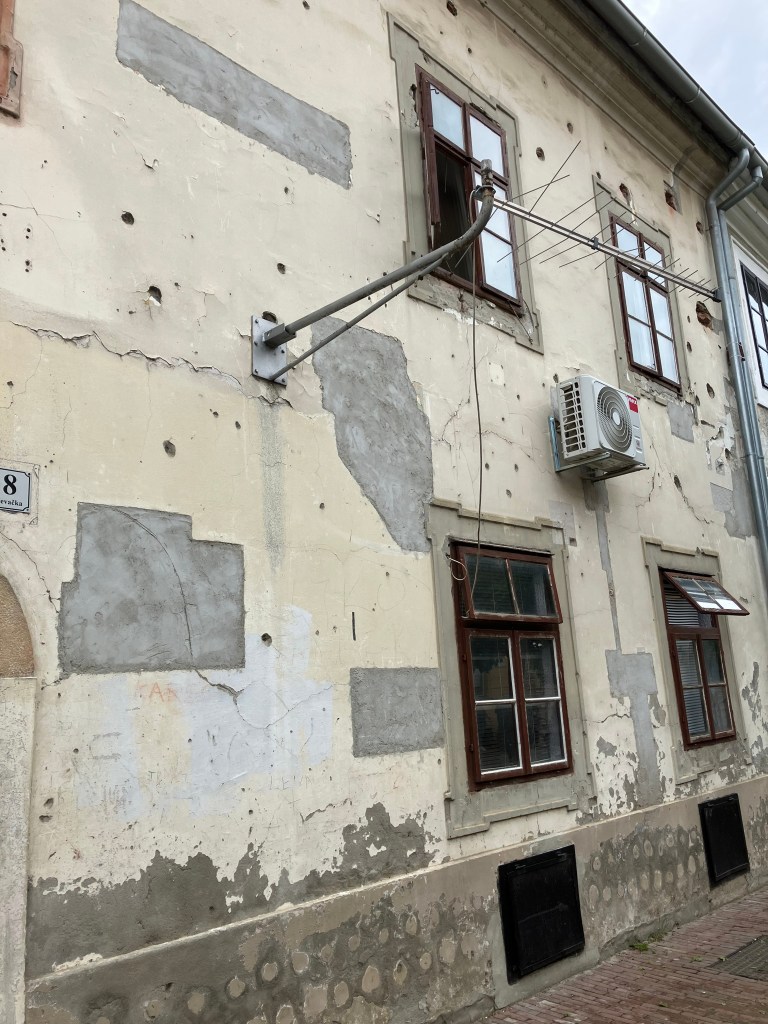
During our own Danube cruise two years ago, in a bookstore in Belgrade, I bought two books by the Bosnian author Ivo Andric that chronicle a long part of this somber history. They are too epic and dense; I can’t read them without a break, so I dive in and out of them like a pearl fisher.
I have appreciated his ironic tone and droll portrayals of the characters on all sides of the drama – the powerful and the helpless, the kind and the venal, the Muslim, the Jew, and the Orthodox Catholic. I have been gaining a sense of what one of his characters calls an “ancient misery,” reaching back for centuries, almost beyond the grasp of memory.
“The hostility is still alive and well after all these years,” Lyndie recently told me on the phone. “I became aware of that from people I spoke to when I was over there last time.”
She had this to say in an email: “One huge difference between Croatians and Serbians (and Muslims, of course) is that Croatia is mostly Catholic like Hungary, and Serbia is firmly eastern Orthodox, like Northern Macedonia. Croatia allied itself with the Nazis and the Vatican during World War II, which caused deep bitterness in the rest of Yugoslavia. A very evil bishop brought famous notoriety to Croatian political history.
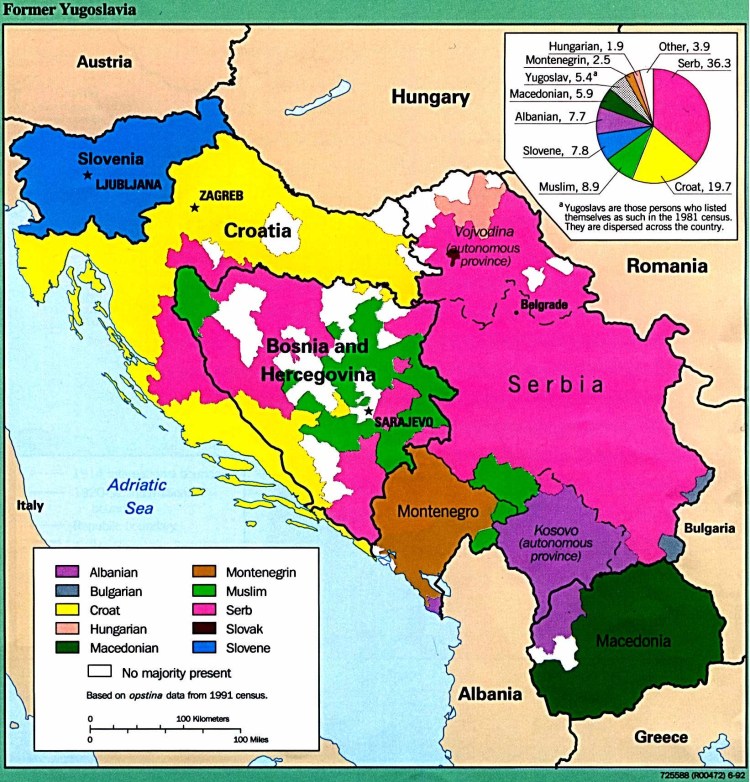
“And of course the Kingdom of Serbia has always wanted the WHOLE peninsula, including Northern Macedonia … Serbians never forget that their ancient “spiritual heart” was Kosovo, now dominated by those pesky upstart Muslims! They absolutely want Kosovo back, if possible before the Second Coming—-as likely to be Putin as anyone else.”
Today, Serbia has 48 military encampments all along Kosovo’s border, waiting, as Lyndie said “for a chance to re-invade as in the 1990s.”
During the previous journey, she told me, “several natives of those nations managed (usually sotto voce) to share their fears of Putin’s ambitions, their fear of local authorities, their distrust of the voting system, the government, their wishes of emigrating to America…..Serbians in particular (survivors of bleak Balkan wars) seem equally fearful of Russia and fellow Yugoslavs.”
Of course the specter of Putin looms over her upcoming adventure. What will be happening as the war in the Ukraine either continues to grind along or approaches an unsettling conclusion? What will she hear this time?
Lyndie’s Serbian friend fears a return of the endless Balkan wars, and worries about her taking this next voyage (but restrains his objections, in deference to her determination).
“If I am patient enough and not in a hurry, sometimes people tell me what they really think and feel,” she went on. “Always, that has been the most meaningful outcome of my travels.”
Thanks to many generous donors (and God willing), Lyndie will lift off in 3 days from the Denver airport, bound for Budapest and on eastward, down its long river. She will experience what she missed two years ago, and will begin to store the memories she has been longing for.
If you’d like, beginning on March 17, you can join her vicariously here, by viewing images and memories from my own experiences on that same cruise two years ago.
After she returns, as soon as possible, the journal she kept while experiencing the voyage will be the final entry on this blog.
Want to start this whole story at the beginning? Click here!
Lyndie sacrificed the experience of a previous journey on the Danube, for which she spent most of her life savings, to help a blind companion who had fallen ill. You can read more about this in Chapter 3.
Friends and strangers have raised nearly $3000 to help Lyndie (re)live her ruined dream of a trip to Eastern Europe. We are still working to restore her savings. To learn more and (if you can) contribute any amount, please click here.
 Lyndie's Journey