
After breakfast with my Montana friends we were joined by a middle-aged couple from Wisconsin, not far from Green Bay, where my Sauber forebears on my mother’s side settled after they emigrated from Germany. I boasted a bit about distant kinsman Charlie Sauber, (in 1920) Green Bay Packers Hall of Fame. The synagogue in Green Bay is right next to the Packers’ playing field and my fantasy is that surely Charlie stopped for a prayer before each game – otherwise how would he have ended up in the Hall of Fame?
I have zero interest in football! But while my husband and sons sat glued to the telly for a game, that always guaranteed me 2 hrs’ uninterrupted reading time! I’m quite proud of cousin Charlie, though. He’s the only person in our family who’s in a hall of fame!
It was an interesting conversation. The husband (from Wisconsin) is a house painter. His wife is an artist, who paints in oils, just as my mother did, never in acrylics. Don’t imagine acrylics even existed in the 1940s! We both share a fondness for the associated “smells” of oil painting: Linseed oil, turpentine , and – of course – the paints themselves.
We both painted, as children, I with full support and encouragement of my mother. And wonderfully, my birth father gifted me with a full set of oils and a roll of canvas, when I was 14!
We talked about barn “culture” in Wisconsin. I asked the man (professional house-painter) what kinds of weather-resistant paint (and how often reapplied) is needed for those beautiful barns. Also asked who paints the hexes on them to keep away witches. He does. We shared impressions of Amish and Hutterite communities in Wisconsin and Montana, also Canada. My husband’s grandmother was daughter of Pennsylvania Dutch settlers not far from Lancaster County. We were all mostly of one mind re: in politics, the state of the nation and the world. I remember driving up to Kenosha in 1956 with my father and his (current) wife to buy a new car. Dinner in Milwaukee. Visiting my half-sister in Madison, meeting my 3 young nieces there. Wisconsin memories.
Last evening: Wonderful live Serbian folk music (violin, drum, accordion); several small pairs, trios or quartets of Serbian folk dancers. Acrobatic, energy-alive, comic antics. What coordination and balance!
Soaking up memories of Serbia to bring home to my special friend, born not far from here, to Serbian parents who survived World War II.
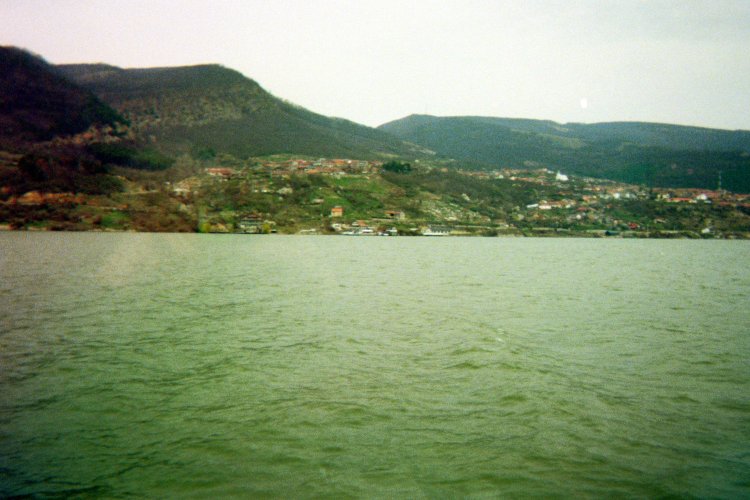
Viewed from the Danube, Serbian villages and small towns cling to the sometimes steep sides of rugged, tree-covered mountains, or on the clefts between them. How silent they seem from this distance! One can only imagine sounds of traffic – mostly sparse – from the narrow highway that runs the length of the river.
In all of the five Balkan countries we visited I saw nothing like a U.S. freeway – all roads limited instead to twin lanes. Some highway bridges are fairly unique, reminding me of the bridges leading from New York City up into Connecticut, their attractive designs resulting from a competition held back in the 1950s(?).
The mountains in Serbia are beautiful. While mostly lacking the stark or jagged outlines familiar to me in Switzerland’s Alps – or our Rocky Mountains – there are countless stunning bluffs and rock outcroppings that hint mysteriously at being human or animal faces, as if sculptured by huge, invisible hands.
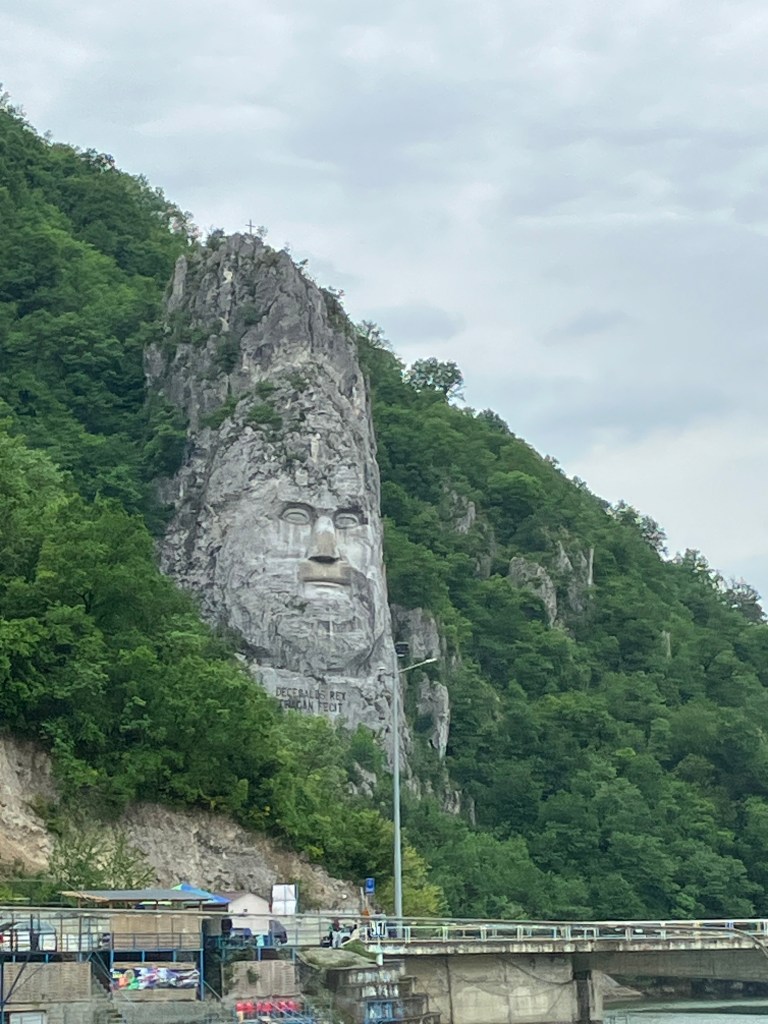
Further downriver, after passing through the dramatic gorges called (cumulatively) the Iron Gate, since they represented with their narrowness a potential for defense against invaders, there is a famous carving of a face of stone ferociously looking down on us as we pass. In this case sculptured by actual human hands, it represents an ancient and famous Dacian monarch dating from the Balkan’s earliest human settlements.
As our boat churns its way steadily toward the locks behind a large dam, the river slows and spreads into what feels like a lagoon … remembering the unique (for me) experience of descending slowly into a deep, dim concrete enclosure like a roof-less dungeon and rising again, with relief, into the sunshine (the huge dam to our left), I was able to describe this process to fellow passengers who had never experienced it.
The actual mechanics of a lock’s function remain as mysterious and magical to me as the deep mysteries of modern technology, in which I remain rather hopelessly uncomprehending – and perhaps lost! I would not want to be stuck in a lock for long – with or without a helpful “device” to save me.

In many places the Danube spreads and widens into a huge, lake-like expanse, reminding one what a significant water course this remains, after thousands of years of European history. It’s the longest river (I believe) in all of Europe.
Hard not to wish it weren’t so awfully polluted. Uncounted human and animal creatures depend for their life upon it.
If you have just come to the journey at this point, please start the chronicle from the beginning to learn the rest of Lyndie’s fascinating story.
Lyndie sacrificed the experience of a previous journey on the Danube, for which she spent most of her life savings, to help a blind companion who had fallen ill. You can read more about this in Chapter 3.
Friends and strangers have raised nearly $3000 to help Lyndie (re)live her ruined dream of a trip to Eastern Europe. We are still working to restore her depleted savings. To learn more and (if you can) contribute any amount, please click here.
 Lyndie's Journey